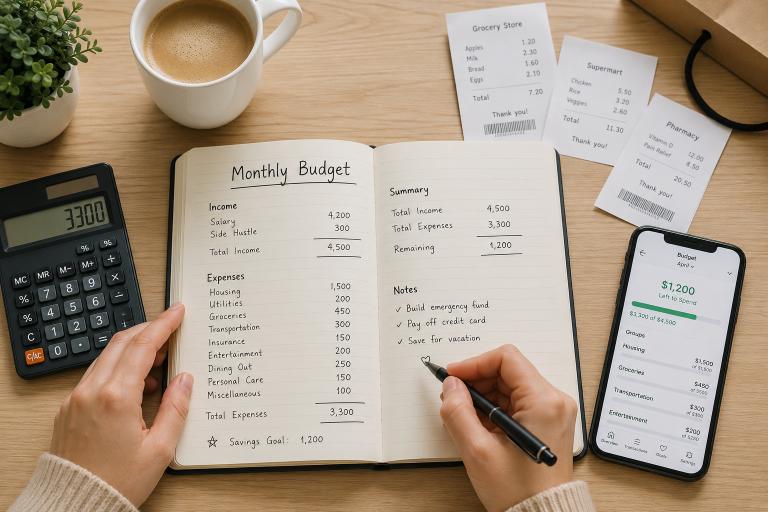
Shopping is one of the easiest places for money to quietly disappear. A coffee here, a “just this once” online order there, a grocery run that somehow costs 40% more than planned — and by the end of the month, you’re wondering where your paycheck went. If that sounds familiar, you’re not alone. Most people don’t overspend because they’re bad with money. They overspend because they never built a shopping budget that reflects how they actually live.
This guide walks you through exactly how to build a monthly shopping budget from scratch, why most budgets fail within the first few weeks, and — most importantly — how to make yours one that actually sticks. Whether you’re budgeting for groceries, clothing, home goods, or general retail spending, the framework below applies to all of it.
By the end of this article, you’ll have a complete, practical system you can start using today, along with templates, tools, and troubleshooting tips for the moments when life doesn’t go according to plan.
1. Why a Shopping Budget Matters More Than You Think
A shopping budget isn’t about restriction. It’s about direction. Without one, your money goes wherever your attention, mood, or the nearest sale takes it. With one, every dollar has a job before it’s even spent.
Here’s why this matters beyond just “saving money”:
It removes decision fatigue. When you already know your clothing budget for the month is $150, you don’t have to agonize over every purchase — you just check it against the number.
It prevents lifestyle creep. As income rises, spending tends to rise with it, often without any real increase in happiness or quality of life. A shopping budget keeps this in check.
It protects your bigger financial goals. Every dollar spent on impulse shopping is a dollar not going toward an emergency fund, debt payoff, retirement, or a vacation you actually care about.
It reduces financial stress. Studies on financial behavior consistently show that uncertainty about spending — not the spending itself — is a major driver of money-related anxiety. A budget replaces uncertainty with a plan.
It builds a healthier relationship with shopping. When shopping is unbudgeted, it can become emotional — a way to cope with stress, boredom, or a bad day. A budget reintroduces intentionality, so shopping becomes a choice rather than a reflex.
None of this requires you to be a spreadsheet expert or a finance nerd. It requires a system — and that’s what the rest of this guide gives you.
2. Understanding the Difference Between a Budget and a Spending Plan
Before building your budget, it helps to understand a subtle but important distinction.
A budget is a limit: “I will spend no more than $300 on shopping this month.”
A spending plan is a strategy: “I will spend $300 on shopping this month, broken down as $150 on groceries, $80 on household items, and $70 on personal items — and here’s when and how I’ll buy them.”
The second version is far more effective. A limit alone doesn’t tell you what to do; a plan does. Throughout this guide, when we say “budget,” we really mean a full spending plan — a number attached to a category, attached to a purpose, attached to a method for tracking it.
3. Step 1: Track Your Actual Shopping Spend for 30 Days
You cannot budget accurately for spending you don’t understand. Before setting any numbers, spend one full month simply tracking every shopping-related purchase — no judgment, no changes to behavior, just observation.
What counts as “shopping” for this exercise:
- Groceries and household supplies
- Clothing and accessories
- Electronics and gadgets
- Home décor and furnishings
- Personal care and beauty products
- Online marketplace purchases (Amazon, Shein, Etsy, etc.)
- Subscription boxes
- Impulse buys of any kind
How to track it:
- Use a notes app, spreadsheet, or budgeting app to log every purchase as it happens
- Include the date, store, category, and amount
- Don’t forget small purchases — $4 here and $7 there add up faster than people expect
- Include both online and in-person purchases
At the end of 30 days, add everything up. Most people are surprised by the total — often by 20 to 50% more than they expected. This number, not a guess, is your real starting point.
4. Step 2: Categorize Your Shopping Expenses
Once you have a month of real data, break it into categories. This step turns a vague “I spend too much on shopping” into specific, actionable insight.
A typical breakdown might look like this:
- Groceries and essentials — food, toiletries, cleaning supplies
- Clothing and footwear
- Electronics and tech accessories
- Home and décor
- Beauty and personal care
- Gifts — birthdays, holidays, special occasions
- Discretionary/impulse — anything bought on a whim, not planned
Categorizing does two things. First, it shows you where the money is actually going — often it’s not the big purchases but the small, frequent ones that dominate. Second, it lets you set different rules for different categories. You might need a strict cap on “discretionary,” while groceries need a realistic, flexible number based on household size.
5. Step 3: Set Realistic Category Limits
With your categories in hand, it’s time to assign numbers. This is where most budgets go wrong — people set limits based on what they wish they spent, not what’s realistic given their actual life and habits.
A better approach:
- Start with your 30-day tracked total for each category.
- Identify categories with obvious waste (duplicate subscriptions, forgotten memberships, impulse categories).
- Trim 10–20% from those categories as a first-round target — not 50%. Aggressive cuts rarely stick.
- Leave essential categories (groceries, household basics) close to their real average, adjusted only for known upcoming changes.
- Add all categories together and compare the total to your overall available budget after bills, savings, and debt payments.
If the total still exceeds what you can afford, go back and trim further — starting with discretionary and non-essential categories first, never with essentials like groceries.
A simple rule of thumb: shopping spending (excluding groceries) should generally stay within 5–10% of your take-home income for most households, though this varies widely based on personal goals and financial situation.
6. Step 4: Choose a Budgeting Method That Fits Your Personality
There’s no single “correct” budgeting method — the best one is the one you’ll actually use. Here are four proven approaches, each suited to a different kind of person.
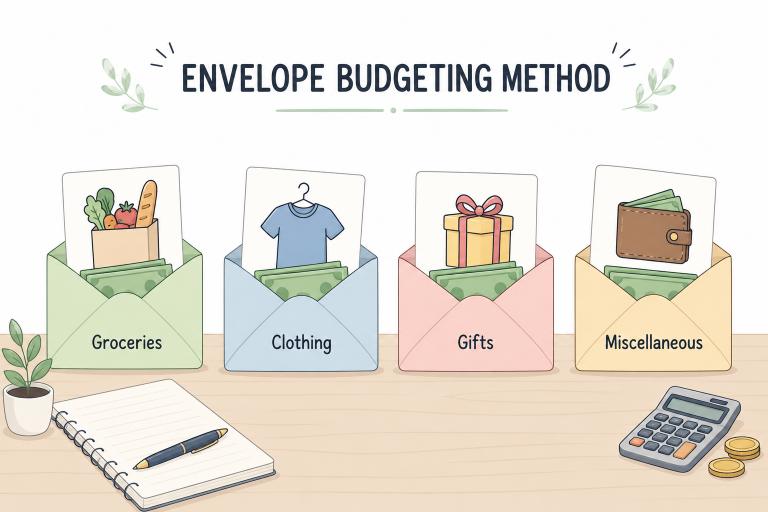
The Envelope Method (Cash or Digital)
Assign a fixed amount to each shopping category and physically separate the money — either with actual cash envelopes or separate digital sub-accounts. When the envelope is empty, spending in that category stops until next month.
Best for: people who overspend because “it’s just a card swipe” and need a hard, tangible stop.
The Percentage-Based Method (e.g., 50/30/20)
Allocate income into broad buckets — for example, 50% needs, 30% wants (including shopping), 20% savings/debt. Shopping falls under “wants” and is capped as a percentage rather than a fixed dollar figure.
Best for: people with variable income who want flexibility month to month.
The Zero-Based Budget
Every dollar of income is assigned a job before the month begins, including shopping categories, so income minus all allocations equals zero. Nothing is left “unassigned” to disappear on random purchases.
Best for: detail-oriented people who want maximum control and visibility.
The Pay-Yourself-First Method
Savings and debt payments are automated first, and whatever remains becomes the pool for all spending, including shopping. This flips the traditional order — spending is what’s left over, not what happens first.
Best for: people who consistently struggle to save because spending always happens before saving does.
Pick one method to start. You can always switch later, but consistency for at least 60–90 days is what reveals whether a method is actually working for you.
7. Step 5: Automate and Systemize Your Budget
Willpower is an unreliable long-term strategy. Systems are far more durable. Once your categories and limits are set, remove as much manual decision-making as possible.
Ways to automate your shopping budget:
- Set up a separate bank account or prepaid card exclusively for discretionary shopping, funded with your monthly limit at the start of each month
- Use budgeting apps that send alerts when you’re approaching a category limit
- Schedule a recurring “budget check-in” on your calendar — weekly is ideal — rather than relying on memory
- Unsubscribe from retailer marketing emails and turn off shopping app notifications, which are engineered to prompt impulse purchases
- Use browser extensions that add a “waiting period” pop-up before completing online checkouts
Automation doesn’t remove your control — it protects your plan from moments of low willpower, which every single person experiences.
8. Step 6: Build in a Buffer for the Unexpected
Rigid budgets break. Life includes unplanned expenses — a friend’s wedding gift, a broken kitchen appliance, a seasonal wardrobe need. If your budget has zero room for these, the first surprise expense will feel like a failure and can derail the entire system.
Build a buffer by:
- Adding a small “miscellaneous shopping” line item (5–10% of your total shopping budget) specifically for unplanned-but-reasonable purchases
- Reviewing upcoming months for known irregular expenses (holidays, birthdays, back-to-school season) and pre-allocating for them in advance rather than treating them as emergencies
- Allowing category limits to flex slightly month to month, as long as the overall shopping total stays on track
A budget that bends without breaking is far more sustainable than one that assumes a perfectly predictable month, every month.
9. How to Actually Stick to Your Shopping Budget
This is the part most guides skip — and it’s the part that actually matters. Setting a budget is easy. Sticking to it is the real challenge. Here’s what makes the difference.
Use the 24-Hour Rule for Non-Essentials
For any unplanned purchase over a set threshold (say, $30–50), wait 24 hours before buying. Most impulse urges fade significantly within a day. If you still want it after 24 hours, it’s a more intentional choice rather than a reflex.
Do a Weekly Money Check-In
Don’t wait until the end of the month to see how you’re doing. A 10-minute weekly review — checking category balances and adjusting the coming week if needed — catches overspending early, when it’s easy to course-correct.
Make Your Budget Visible
People who track spending visually (through an app, spreadsheet, or even a printed chart on the fridge) tend to stick to budgets better than those who only check mentally. Visibility creates accountability, even when no one else is watching.
Plan Shopping Trips Instead of Wandering Into Them
Whether online or in-store, shop with a specific list and purpose. “Browsing” — especially on retail apps or during sales events — is one of the biggest drivers of budget-breaking purchases.
Identify Your Personal Triggers
For many people, shopping overspend is linked to specific triggers: stress, boredom, social media scrolling, sales emails, or even certain times of day. Once you notice your own pattern, you can build a specific counter-habit — like a walk instead of a scroll, or unsubscribing from the retailer whose emails always get you.
Reward Yourself for Staying on Track — Without Spending
Celebrating a successful budget month with a shopping splurge undermines the entire system. Instead, use non-spending rewards: a relaxing evening, telling a friend about your progress, or simply tracking your growing savings as its own reward.
Expect Setbacks and Plan for Them
An overspent month doesn’t mean the system failed — it means you’re human. The key is not letting one hard month spiral into abandoning the budget altogether. Return to the plan the following week, not the following year.
10. Common Shopping Budget Mistakes (and How to Avoid Them)
Even well-intentioned budgets fail for predictable reasons. Watch for these common pitfalls.
Setting limits too low, too fast. Cutting your shopping budget by 60% overnight rarely lasts. Gradual, sustainable reductions stick far better than dramatic ones.
Forgetting irregular expenses. Holiday shopping, birthdays, and seasonal needs often get left out of monthly budgets, causing a “surprise” that wasn’t actually unpredictable.
Not tracking small purchases. A $6 impulse buy feels harmless in the moment, but a dozen of them can quietly consume an entire category’s budget.
Using one big “shopping” category instead of specific ones. A single vague category makes it hard to see where overspending is actually happening. Specific categories create specific accountability.
Comparing your budget to someone else’s. A budget should reflect your income, obligations, and goals — not a number you saw online or a friend’s spending habits.
Treating the budget as punishment. A budget built entirely around restriction and guilt is hard to sustain. A budget built around intentional choices and clear priorities is far more durable.
Not reviewing and adjusting monthly. A shopping budget isn’t “set it and forget it.” Life changes, prices change, and priorities shift — the budget should be revisited every month.
11. Tools and Apps to Help You Stay on Track
You don’t need expensive software to budget well, but the right tool can make consistency far easier.
- Spreadsheet templates (Google Sheets or Excel) — fully customizable, free, and private
- Budgeting apps with automatic bank syncing and category tracking, which reduce manual entry
- Envelope-style banking apps that let you create digital sub-accounts for each shopping category
- Browser extensions that add friction to online checkout, encouraging a pause before purchase
- Notes app or simple notebook — for those who prefer a low-tech, manual approach, this works just as well as an app if used consistently
The best tool is the one that matches how you naturally think about money. A finance nerd may love a detailed spreadsheet; someone who wants simplicity may do better with a basic app that just shows one number: “how much is left this month.”
12. Sample Monthly Shopping Budget Template
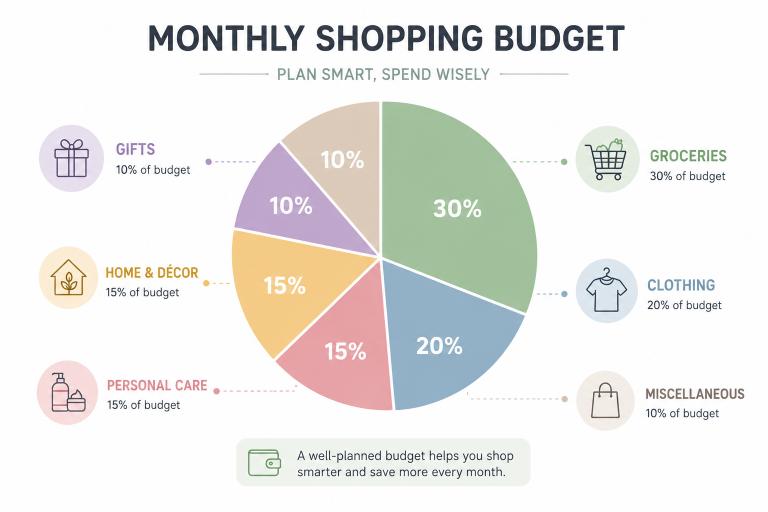
Here’s a simple starting framework you can adapt to your own numbers. This example assumes a total monthly shopping budget of $400, excluding bills and fixed essentials.
| Category | Monthly Limit | Notes |
|---|---|---|
| Groceries & household essentials | $220 | Adjust based on household size |
| Clothing & footwear | $50 | Roll over unused amount monthly |
| Personal care & beauty | $30 | Include haircuts, skincare, etc. |
| Home & décor | $25 | Save up across months for bigger items |
| Gifts (birthdays, occasions) | $35 | Pre-plan around known dates |
| Miscellaneous/buffer | $40 | For unplanned but reasonable purchases |
| Total | $400 |
Adjust every number based on your own tracked spending from Step 1 — this template is a starting structure, not a fixed rule.
13. FAQs
How much should I spend on shopping each month?
There’s no universal number — it depends on income, obligations, and goals. A common guideline is keeping non-grocery shopping within roughly 5–10% of take-home pay, but your own tracked spending and priorities should guide the final number.
What’s the easiest budgeting method for beginners?
The envelope method (physical or digital) tends to be the easiest to understand and stick to, since it creates a clear, visible stopping point for each category.
How do I stop impulse buying?
Use a waiting period (24–48 hours) before non-essential purchases, unsubscribe from retailer marketing, and identify your personal triggers so you can address the root cause rather than just the symptom.
Should groceries be part of my shopping budget?
Yes — groceries are one of the largest and most variable shopping categories for most households, and tracking them separately from discretionary shopping gives a clearer picture of spending.
What if I go over budget one month?
Review what happened, adjust the following month if needed, and get back on track immediately rather than abandoning the system. One difficult month doesn’t undo the value of the process.
Do I need an app to budget effectively?
No. A notebook or spreadsheet works just as well as an app, as long as you track consistently and review regularly.
A monthly shopping budget isn’t about depriving yourself — it’s about deciding, in advance, what actually matters to you, and making sure your money supports that. The process outlined here — tracking real spending, categorizing it honestly, setting realistic limits, choosing a method that fits your personality, automating what you can, and building in flexibility — isn’t a quick fix. It’s a system.
Systems outlast willpower. The goal isn’t a perfect month; it’s a sustainable one. Start with your first 30 days of tracking, be honest about the numbers, and build from there. Every month you follow the process, it gets a little easier — and a little more automatic — until budgeting isn’t something you have to think about anymore. It’s just how you shop.

Leave a Reply